
The idea of a specialised university, such as HafenCity Universität Hamburg, is not fundamentally new, and yet it was and remains so in this specific instance. The founding of “HCU” is not merely an act of political will, but also an extraordinary experiment. A pre-programmed clash of cultures leading to the genesis of a “new type of university” – this is how one might interpret the decision, based on the founding documents from 2006. Bringing together people from the Technical University of Harburg, now the Technical University of Hamburg (TUHH), the Hamburg University of Applied Sciences (HAW) and the University of Fine Arts (HfBK) in a melting pot dedicated to architecture and urban development is unique within the academic landscape of the Federal Republic of Germany and its history.
The name ‘HafenCity Universität Hamburg’ alone certainly does not initially suggest any such interpretation; moreover, it is clear that the HCU did not actually begin in the HafenCity that gave it its name, but was spread across various locations until the building at what is now Henning-Voscherau-Platz 1 was completed in 2013. To describe this phase as “chaotic” would not do justice to the history, but it does clearly show that the history of HCU was by no means straightforward, even in its founding decade. With Prof. Steven Spier and Dr Walter Pelka, as well as – on several occasions – Prof. Dr Harald Sternberg in an interim capacity, three presidents developed the university into a manageable form. And with the move into the current main building, this development initially took hold. Cost pressures and budget constraints, as well as differences that could not be overlooked, have repeatedly led the university into difficult phases. The change in the presidency in 2019 triggered several changes at once; above all, additional focal areas – “Climate (Protection)” and “Digitalisation” – were established, which, at the intersection with building culture and metropolitan development (the HCU’s subtitle), open up new options. Furthermore, with “TGA” (Smart Building Engineering), focusing on digital infrastructure – now known as TGAmitDI – a new degree programme was established for the first time. With six Bachelor’s and six Master’s programmes, the HCU is now broadly and well positioned for the future, despite its relatively small size. In doing so, the HCU has freed itself from budgetary constraints through its own efforts and carved out new opportunities – this was the only way, for example, that the temporary use of the “Märchenwelten” on Baakenhöft, directly opposite the HCU, was possible from the start of the pandemic.
In academic terms, HCU has since succeeded for the first time in securing the DFG’s ‘Urban Future Making’ research training group as a flagship initiative at the university and in establishing a key international partnership with UN-Habitat. Furthermore, the HAWICC (Hanseatic Wireless Innovation Competence Centre) has been established at HCU as a testing ground for the Federal Ministry of Transport’s German Centre for Future Mobility. Furthermore, through a collective effort, the HCU has managed to cut through a Gordian knot, particularly over the last two years. With a new Chancellor and the organisation into departments, the HCU stands in a significantly stronger position than it did in 2023, based on a new constitution and a cultural code developed and adopted jointly. In agreement with the university senate, the university council and the university leadership, something has been created that falls under the heading of ‘daring to be more of a university’. In 2026, the HCU now stands on the threshold of embarking on the next phase of its existence.
Central and significant to any university are the students from all fields and disciplines – inter- and transdisciplinarity shape the culture of the HCU. HCU students have provided valuable impetus for campus culture with many new ideas, such as the Headland Festival, Campuszauber, exhibitions and the Room of Tranquility, which is currently under development.
I would like to extend my heartfelt thanks, on behalf of everyone, to the AStA and the student councils – for at least the past seven years, I have always taken great pleasure in observing our students during all our discussions, as they demonstrate forward-thinking, commitment and a determination to make a positive difference – blessed is the university that has such students.
Over the last two years, the staff have, in particular, built a new culture of collaboration between administration and academia. In the academic sphere, alongside major projects, many successes have been successfully secured and implemented both in the traditional field of research (e.g. DFG projects) and in knowledge transfer (e.g. Blue-Green Streets). None of this would have been possible without the members of the university. It is to them, first and foremost, that I owe a debt of gratitude. This applies in particular to the members of the current presidential board: Prof. Dr. Annette Bögle (Vice-President for Research and International Affairs), Prof. Karsten Schlesier (Vice-President for Academic Affairs) and Dr. Volker Pekron (Chancellor of the HCU).
And alongside them, an equally big thank you goes to the HCU community, in particular the university council (chaired by Dr. Georg Mecke) for its tireless and exceptional work on behalf of the HCU. I would also like to thank the lecturers and the many people who, as benefactors (e.g. the Suhr Foundation, the Sutor Foundation, the Vorwerk Foundation), have time and again supported HCU and the people at HCU.
The HCU is now turning 20. If the HCU were a young person, one might say that the time for studying and the next phase of life’s maturity is now upon us. It is not exactly the same, yet it is a little like that. The HCU is entering the next decade well-strengthened from within. Together and united, we stand for the HCU model of success and will continue to write this chapter of our history as a firm anchor of Hamburg’s academic system.
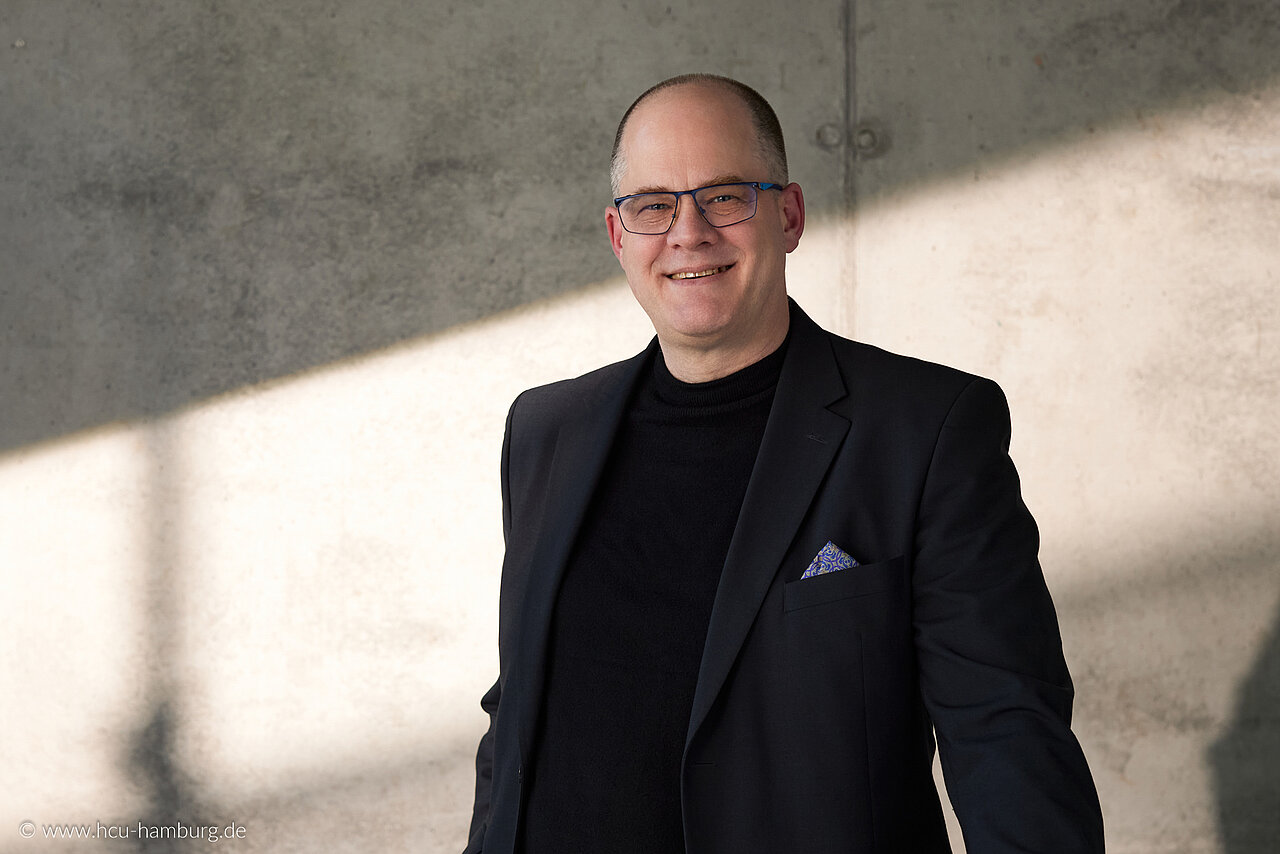
Prof. Dr. Jörg Müller-Lietzkow,
President of HafenCity Universität Hamburg