

20 years of eventful history, or 20 years of HCU
Not a retrospective, but reflections on (academic) freedom
Dear Senator, dear Maryam Blumenthal,
Dear State Councillor, dear Ms Gümbel,
Dear State Councillor, dear Alexander von Vogel,
Dear Members of the Hamburg Parliament,
Dear fellow presidial colleagues,
Dear colleagues of the presidents of Hamburg’s universities,
Dear Chair of the university council, dear Georg Mecke,
Dear members of the university council,
Dear Vice-President, dear Annette Bögle,
Dear Vice-President, dear Karsten Schlesier,
Dear Chancellor, dear Volker Pekron,
Dear colleagues,
Dear student representatives,
Dear former colleagues and students of the HCU,
Dear guests from near and far, all of whom are connected to our HCU in one way or another,
There are easier speeches than the one I have been given the honour of delivering today. Today, we must and should strike a balance: in what is certainly a challenging situation for HCU, we must convey a certain light-heartedness on the occasion of our 20th birthday, whilst remaining clear and unambiguous. I therefore ask for your forgiveness in advance for refraining from a purely light-hearted eulogy, whilst still wishing to highlight one or two achievements of and by the people at and within HCU.
I would also like to ask, however, that we view this special day for what it is: a birthday. And birthday boys and girls are allowed to make a wish. I shall return to this wish at the end of my short address – before we move on to the usual closing line of such speeches: There is only me standing between you and the meal – I shall endeavour not to overrun the time ;)
1. Freedom and academic freedom
Let me begin this evening with a thought: what if academic freedom were no longer guaranteed? What happens in a country where we dictate how people should think? Do we really want an indoctrinated academic community that, beyond the pursuit of knowledge, follows ideological agendas? That can, must not, and should never be our guiding principle in free democracies.
And of course, there are certainly limits, but these must not be motivated solely by political or economic considerations. Through peer review and many other appropriate systems, science has made quality assurance an essential part of its culture. One would think that this, in fact, ought to be the basic consensus in free democracies worldwide. But far from it. I quote from Monday’s Zeit newsletter:
“US government overturns peer review
The dismantling of science in the US continues. The latest blow: Political officials are no longer to be guided by the verdict of scientific expert reviews when awarding grants (npr, cnn). Put another way, and in much sharper terms: In future, science in the US will be funded at the whim of politicians. “This would be the end of American science as we know it,” declared Cole Donovan of the “Stand up for Science” initiative. But it hasn’t come to that yet: “We’re going to make sure that it doesn’t fade quietly into the night” (npr). There is widespread resistance to the White House’s planned changes to administrative regulations, and the scientific community worldwide is alarmed (Research.Table). Scientific associations, universities and academics from all disciplines are in uproar and determined to save the primacy of peer review: “The system wasn’t perfect, but it wasn’t stupid,” CNN quotes climate researcher Kate Marvel as saying, “putting uninformed political hacks in charge of it is deeply stupid.”
The public consultation on the proposed changes runs until 13 July. Observers expect a flood of submissions. However, it is considered unlikely that this will dissuade the White House from its course or lead to a review by Congress (CNN).
Certainly, this sort of situation cannot (yet) be observed in Germany today. Nevertheless, even here – particularly against the backdrop of the threat of extremist governments in eastern Germany – it seems essential to protect university autonomy, and above all academic freedom, at all costs, as well as to ensure adequate funding so that universities can fulfil the tasks imposed upon them well, fully and autonomously. And this must be done without external control through financial intervention! It is not without reason that this has constitutional status here under Article 5.
2. The four central tasks
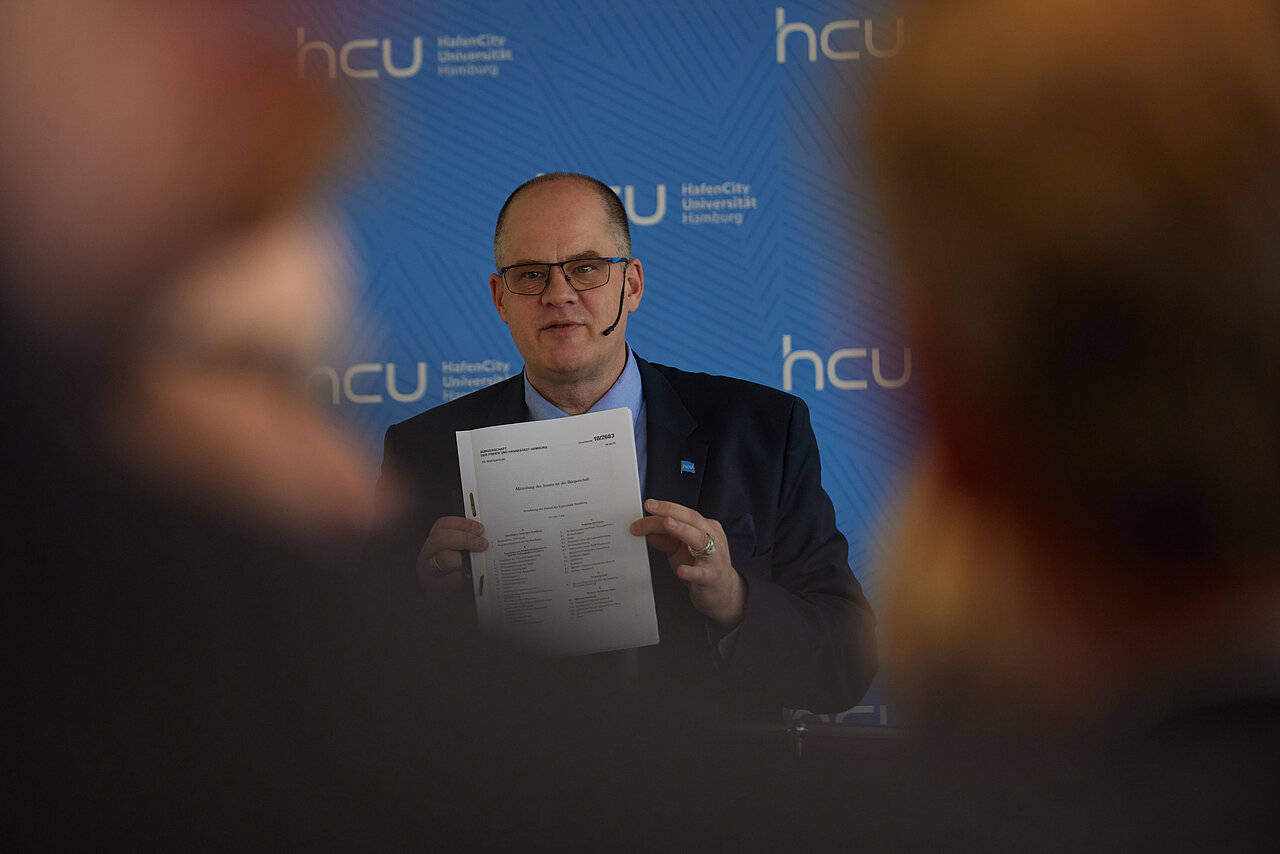
Whilst preparing for this short speech, I took a brief journey into the past to enable a glimpse into the future in the context mentioned above. In the founding document 18/2683 of the 18th legislative period of the Hamburg Parliament (Bürgerschaft) of the Free and Hanseatic City of Hamburg from 2005, four key tasks were set out for the HCU:
- Education: The university is to offer high-quality and innovative Bachelor’s and Master’s programmes that lay a solid foundation for established professional fields but also open up new ones.
- Research and development: The new university is to develop a clear profile in research and development that, in particular, utilises its interdisciplinary potential to break new ground.
- Transfer: HafenCity Universität is to engage with the city and its citizens, the business community and the cultural sector through needs-based offerings in teaching, research and development. As a forum for lively discussion, it is to contribute to the development of Hamburg’s distinctive architectural heritage and to issues of urban development.
- Excellence: In defined specialist focus areas, HafenCity Universität must also be competitive and excel on an international scale.
On its 20th anniversary, it is only right to ask: has HCU met these expectations? Let me begin with a teaser: the highly motivated people at HCU have far exceeded them with great passion and personal commitment. And for this, all those who have contributed deserve thanks, respect and recognition for a (very) extraordinary achievement.
Certainly – let’s not kid ourselves – there have also been difficult times, particularly in 2017 and 2018, as well as 2024. Yet it is precisely following the last crisis that HCU has emerged as a stronger university – together we have “dared to be more of a university”, as our University Council Chair urged us to do! Not only have we jointly adopted a new Basic Order as the constitution of our university, but, in addition to the long-planned, successful transition of the organisation into departments, we have also drawn up a Cultural Code that defines our collaboration as fair, on an equal footing and as a participatory, transparent process.
But let me now turn to our key figures in comparison with the demands of that time.
2.1 Education
Today, HCU offers 6 Bachelor’s and 6 Master’s programmes. This is no fewer than 4 more than the original Bachelor’s and Master’s planning (Civil Engineering, Architecture, Geomatics and Urban Planning) had envisaged. In doing so, we have succeeded in maintaining the balance between traditional academic teaching and practical, real-world applications.
Today, contrary to the founding document, HCU admits over 100 more students per year (currently 680 compared to 575). What is remarkable is that this is achieved with fewer staff than envisaged in the founding document. At the same time, as we are very successful in securing external funding, our staff numbers have grown significantly – today, 387 people work at the HCU!
It becomes even clearer when one sees that, in addition to the undergraduate programmes outlined in the founding prospectus – with the change from Geomatics / Geodesy and Geoinformatics, Metropolitan Culture, Hydrography, Smart Building Engineering / Technical Building Equipment with Digital Infrastructure, Resource Efficiency in Architecture and Planning, and Urban Design. The latter Master’s programme in particular, now fully taught in English, is the only one of its kind in Germany outside the TU Berlin.
Teaching at HCU is not limited to the traditional 90-minute format either. Experimental teaching, field trips, Impromptu sessions and other innovative formats round out the portfolio. This is ensured by our professors, research staff and our valued lecturers, whom I would like to thank, as well as the dedicated administrative staff who have been supporting our teaching for decades (as we can now say).
And we have highly committed students – for us, research-based, inter- and transdisciplinary teaching is not just a buzzword, but a living reality. We approach the AI era with an open mind and curiosity, striking a balance between traditional and classical teaching, innovative formats and practical training elements. We are very proud of our graduates, many of whom receive job offers whilst still studying and are, in the truest sense, building a piece of the future for us all.
In figures: HCU is in high demand and ‘fully booked’ (with over 2,600 students instead of the planned 1,500) across (almost) all programmes. Only our newest programme is just beginning to grow (more strongly). It is very important to continue developing a functional structure here, as we need precisely these skills more than ever – one need only think of the Stuttgart 21 fiasco.
2.2 Research and Transfer
In research, the HCU has developed significantly further than one might have expected given the original Clash of Cultures. This success is not limited to individual and internal collaborative projects; in recent years, the HCU has been particularly successful in its external collaborative projects, specifically with partner universities in Hamburg, foremost among them the TUHH and the UHH. It has established itself as an integral part of the national academic landscape and has achieved success with federal ministries, the EU and the DFG alike.
This successful path would not have been possible without effective collaboration between research and administration. In this regard, I would like to take this opportunity to express my gratitude in advance to all those who have played a key role in this significant growth and success – we in academia are all familiar with the late-night grant application sessions, as well as the indispensable, much-needed and highly valued support provided by the dedicated staff in administration. Without these two components – the will, the curiosity for research, but also the helpful support and expertise – one cannot succeed.
In figures, the research training group alone, together with UNITAC within the framework of UN-Habitat, CUT (Connected Urban Twin), the Dar Safi project and the HAWICC projects, has cumulatively secured well over 60 million euros in third-party funding since 2019 (most of which is still ongoing). This certainly represents a good mix. A DFG research training group is, in principle, more firmly rooted in the field of basic research. The other projects are more firmly rooted in hybrid or applied research.
Just how fundamental this type of research and knowledge transfer is can be seen in many areas, such as UNITAC, CUT (CSL), DAR SAFI, SURE and the numerous projects within HAWICC. This not only enables HCU to further establish its position within the research landscape, but also opens up opportunities for many talented individuals to undertake research projects, whilst also fulfilling the original mandate. We view knowledge transfer as both an economic and a social responsibility.
And to put it ‘in stark numerical terms’, when research and knowledge transfer are combined, HCU now has a ratio of 56% third-party funding to 44% budget funding. To put this into perspective: with over 56% of expenditure coming from third-party funding, HCU – which stood at 45% of this ratio in 2019 – has once again made significant progress. This is a further indicator of the high level of commitment and performance of researchers at HCU.
Added to this – and this is often forgotten – is the fact that the HCU participates very successfully in architectural competitions, our publication output has increased, we have become significantly more successful in DFG research (including individual projects), and many of the HCU’s post-docs are securing professorships nationwide and even internationally. All of this speaks to an active and highly structured approach. Once again – and I find this very important – the key to success here is the interplay between academia and administration; for this, thanks, respect and recognition go to everyone involved.
And – a little teaser – I have long dreamt that, in the coming years, we might also take the lead in establishing a Collaborative Research Centre of the German Research Foundation at HCU. We have built up the capability to do so, and you should all be proud of that. Combined with the uniqueness of the chairs represented at HCU, we believe there is a good chance of this. This ties in directly with the final point of the founding document: excellence.
2.3 Excellence
Now, a legitimate question might be: has HCU also lived up to the fourth point, ‘Excellence’, in its first 20 years? If one were to measure this solely by the Excellence Initiative, one can at least note that HCU is a participant in the CLICCS Cluster of Excellence. However, if one takes a broader view of the concept of excellence and considers the uniqueness of, for example, the internationally highly renowned “REAP” degree programme or the only hydrography degree programme in Germany.
It is also unusual for a small university that extensive agreements and collaborations have been established with leading institutions in the US scientific community, including the famous MIT (Boston, USA; CSL since 2015), the long-standing IIT (Chicago, USA) and the RIT (Rochester, USA; officially since 2025).
I would like to highlight – once again – the DFG research training group, which was recently extended following the site visit with the brief tagline “Urban Future-Making sets standards”. Furthermore, the HCU – and it would be wonderful if this opportunity were seized – is also actively involved in establishing the German Research Centre for Artificial Intelligence, initially as a real-world laboratory and subsequently as a permanent site in Hamburg. Similarly, one could infer excellence from the fact that the HCU is, after all, one of the four – soon to be five – sites of the German Centre for Future Mobility of the Federal Ministry of Transport (BMV).
Against the backdrop of this broader understanding and the existing framework conditions, I believe we can certainly speak of excellence.
Please judge for yourselves whether and how we have fulfilled the 20-year-old mandate – for my part, at least, I can only express my heartfelt thanks on behalf of everyone who benefits from this enormous achievement by the HCU. The city can plan with us and rely on us – we are absolutely reliable partners!
3. What does our new best friend – AI – say?
Now another important question arises: How do we stand in relative terms? What do we use as a benchmark? In a typical metrics-driven world – which is not always ideal for science – one can at least attempt to address this using Excel logic. Added to this, we have a ‘new best friend’ – AI.
I once asked this very AI:
“If you consider the figure in the context of the HCU’s founding or a university budget, I can also calculate what present-day value the €13.4 million would have, taking into account the significantly higher costs for:
* Staff (TV-L),
* Construction costs,
* Energy,
* IT/digitalisation
In universities, the real increase in costs since 2006 has typically been significantly higher than general consumer price inflation. This would suggest a present value of around €28 million, depending on the cost structure.”
However, the bare figure alone is not enough, given that the founding document originally stipulated 65 professorships – unfortunately (!) this level could not (or was not allowed to?) be maintained, as the overall budget would not permit it.
All the more astonishing is the third-party funding ratio of 56%. The AI comments:
“Given the disciplinary structure of HafenCity Universität Hamburg (Architecture, Civil Engineering, Urban Planning, Geomatics, Urban Studies), one would not typically expect third-party funding ratios comparable to those at TUM, RWTH or KIT in a German context. A ratio of around 25–40% third-party funding relative to core funding would already be a good to very good figure.”
Or, to put it in per capita terms (W3 and W2 professorships), where we currently stand at – depending on the calculation method – 335,000 (including junior professorships) or 365,000 euros. The AI comments:
“For the strategic management of an institution such as HCU or a centre such as HAWICC, I would therefore regard an average target figure of €200,000 per professorship per year as ambitious but realistic. From an average of €300,000 across all professorships, the university would already be well above the level of many small and medium-sized German universities.”
Of course, the AI is not omniscient, and one might accuse me of the figures being influenced by the prompts – let me tell you this: the German Association of University Teachers publishes many of these figures in the conventional way. In a reality check, you will find that the AI paints a clear and honest picture: the HCU is – measured by its size and the resources at its disposal – exceptionally high-performing, and we have not even yet discussed awards, competition entries, artistic and architectural works, the high quality of academic publications, etc.
Without wishing to overdo it: everyone at the HCU makes a contribution to our overall success that is far above average. For this, my sincere thanks!
4 Freedom and Justice
Let me return once more, as we draw to a close, to the idea of freedom from the beginning. (Academic) freedom is the fundamental prerequisite for being able to pursue the core of science – namely, the creation of knowledge – unhindered. However, if the necessary foundations for this are undermined by external political influences, there is a danger that we will no longer be ‘generating knowledge’, but instead set in motion entirely different developments.
This makes it all the more important that institutions such as our HCU are protected from any form of encroachment. We do not always have to agree, for it is often in discourse, and indeed in debate, that the essence of insight and the solution can be found. However, once an agreement has been reached – that is, once a mutually agreed and contractually binding consensus has been established – this must be upheld to ensure the reliability of planning for the institutions.
We must ensure that we can continue to fulfil our duties as we have done so far, so that the success story of one of Germany’s smallest universities can continue as we all wish and as was once agreed. This also entails acting fairly and reliably. The American philosopher John Rawls put it as follows in 1970, the year of my birth, in his Theory of Justice:
“Let us therefore imagine that those who wish to unite in social cooperation choose, in a joint act, the principles by which fundamental rights and duties and the distribution of social goods are determined. People should decide in advance how they wish to regulate their claims against one another and what the founding document of their society should look like. (…) The decisions that reasonable people would make in this theoretical situation of freedom and equality determine the principles of justice. (…) One could call the original state the appropriate initial state, and thus the agreements made within it are fair. This justifies the term ‘justice as fairness’. It expresses the idea that the principles of justice are established in a fair initial situation.”
Right at the start, I said that I would return to the birthday wish. It is quite simple:
To everyone who cares deeply about HCU: Let us continue to develop this university together, harness its unique potential, and ensure that we create the best possible conditions for our students in a fair, open and collaborative manner. They are the future of Hamburg, they are our future, on whom we can rely when in doubt. They deserve our full commitment so that they can develop their potential to the fullest in a free world. This must not be sacrificed to budget constraints; on the contrary, we must press ahead courageously and spare no effort – for a better, more sustainable, more diverse and fairer science-based society, which I wish for this generation and for all of us on this special anniversary, and in particular for the whole of HCU.
On this anniversary, I would like to offer my heartfelt congratulations to you, and indeed
to us all –
today we are all (once again) ‘20’!